 and
and
AI campus hiring platform
AI campus hiring platform: 14,000 candidates, 50 campuses, one week
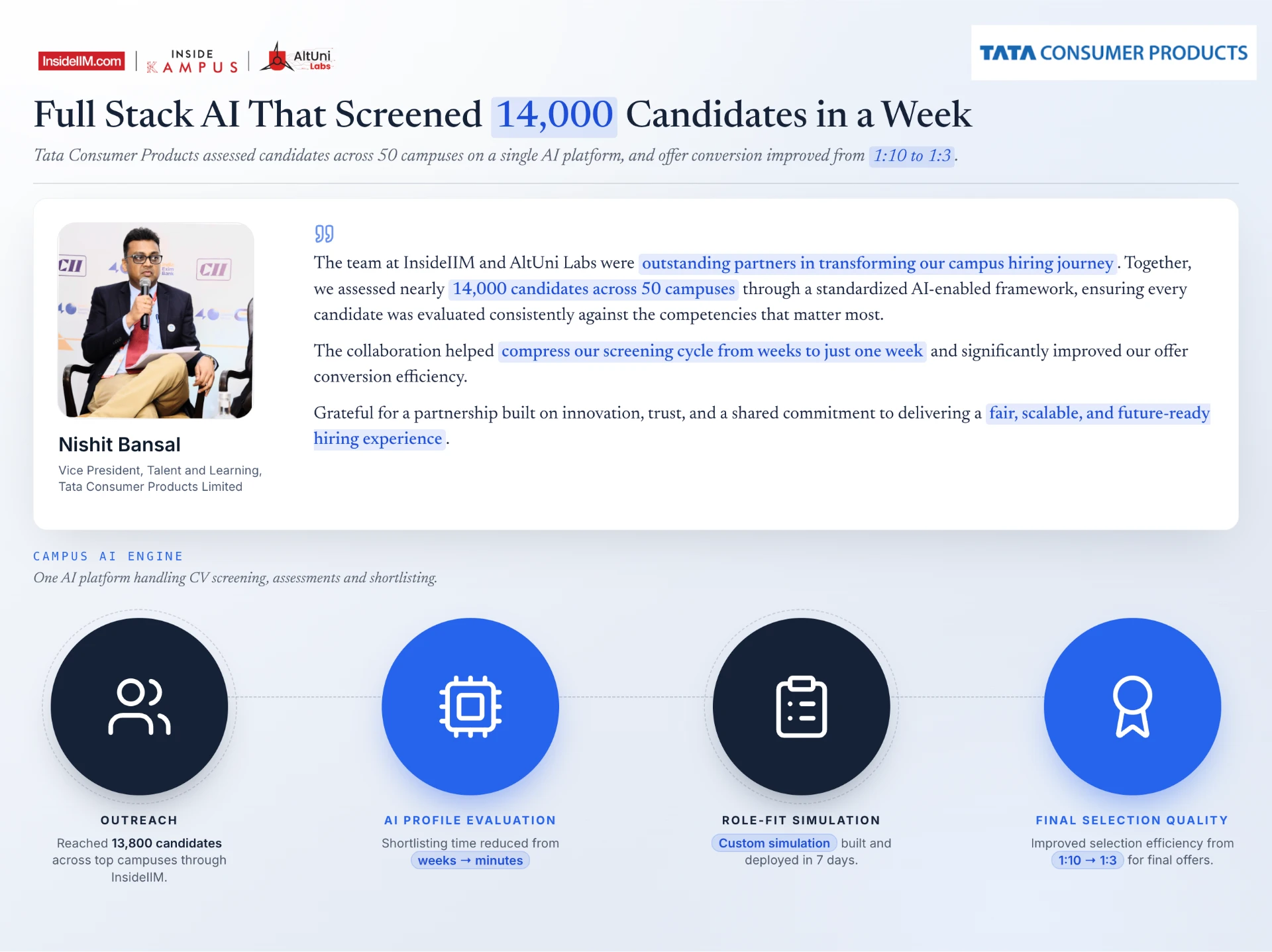
Tata Consumer Products ran its summer trainee hiring across 50 campuses on a single AI campus hiring platform built by InsideIIM and AltUni Labs. Nearly 14,000 candidates were assessed through one standardised AI-enabled framework. A custom business simulation was designed end to end by subject matter experts and deployed in under a week to fit a campus calendar that had already started. Shortlisting fell from weeks to minutes, the full screening cycle compressed to a single week, and offer conversion efficiency improved from 1:10 to 1:3.
1:10 → 1:3
Offer conversion efficiency
~14,000
Candidates assessed across 50 campuses
Weeks → one week
Full screening cycle
Under 7 days
Custom simulation designed, built and deployed
Problem: 50 campuses, one live calendar, and no time to pause
The season had already started. That constraint shaped everything else.
Two things had to hold simultaneously, and conventional approaches force a trade-off between them.
- One evaluation standard across every campus. A shortlist that cannot be compared across campuses is not a shortlist. When each campus runs its own process, a strong candidate at one and a strong candidate at another are not the same claim.
- Speed, because the build could not wait. A months-long design cycle would have missed the season entirely. Whatever was built had to go live inside a live calendar.
- A funnel that was converting badly. At 1:10, nine of every ten offers made were not converting into the outcome the team wanted, a signal that the interview stage was receiving candidates it should not have been receiving.
Solution: One AI campus hiring platform across the whole funnel
CV screening, assessment and shortlisting ran on the same platform. Every candidate carried one continuous record from application through to offer, scored against one competency framework at every stage, with outputs structured to feed final shortlisting decisions directly.
This is the part that is easy to underrate. Multi-vendor funnels break at the joins: the assessment tool does not talk to the screening tool, the shortlist arrives as a spreadsheet, and nobody can trace why a candidate ranked where they did because the evidence sits in four systems.
The four stages
Outreach
- What ran
- Campus outreach across the InsideIIM community, ahead of the formal season
AI profile evaluation
- What ran
- Every candidate scored against the same competencies on the same framework, taking shortlisting from weeks to minutes
Role-fit simulation
- What ran
- Custom business simulation designed end to end by subject matter experts, built and deployed in under a week
Final selection
- What ran
- Ranked shortlist structured to plug straight into final decisions
| Stage | What ran |
|---|---|
| Outreach | Campus outreach across the InsideIIM community, ahead of the formal season |
| AI profile evaluation | Every candidate scored against the same competencies on the same framework, taking shortlisting from weeks to minutes |
| Role-fit simulation | Custom business simulation designed end to end by subject matter experts, built and deployed in under a week |
| Final selection | Ranked shortlist structured to plug straight into final decisions |
The simulation
A short, timed business simulation across two modules, built entirely on Tata Consumer's own business context.
Consumer-first field decisions. Real business scenarios from the field, each presenting a distinct challenge requiring strategic thinking and consumer-first planning: budget allocation, consumer trial decisions, cross-functional collaboration, and trade-off decision making under constraints.
Ethics code in action. Situational judgement scenarios testing moral reasoning against ethical decision-making frameworks, covering structured judgement, brand reasoning justification and values-based decision making.
Every decision moment came from Tata Consumer's own consumer and portfolio context, so candidates were assessed inside the business they were applying to join. A single version ran across all 50 campuses, which kept every candidate on identical ground and made cross-campus comparison direct.
Built for a calendar that had already started
The simulation was designed from scratch by in-house subject matter experts, validated before going live, and deployed in under a week. It was not assembled from a question bank.
The inputs required from the client were the competency framework, the role context and a review cycle. Delivery, outreach, candidate support and reporting sat with our team.
Impact
- Nearly 14,000 candidates assessed across 50 campuses on one platform, against one framework
- Offer conversion efficiency improved from 1:10 to 1:3
- Screening cycle compressed from weeks to a single week
- Shortlisting time reduced from weeks to minutes
- Custom simulation built from scratch and deployed in under a week, inside a live campus calendar
- One continuous candidate record from application through to offer, with the evidence attached at every stage
Before AI and after AI
Shortlisting time
- Before AI
- Weeks
- After AI
- Minutes
Full screening cycle
- Before AI
- Weeks
- After AI
- One week
Offer conversion efficiency
- Before AI
- 1:10
- After AI
- 1:3
Evaluation standard
- Before AI
- Varies by campus and reviewer
- After AI
- One framework across all 50 campuses
Assessment design
- Before AI
- Off-the-shelf or question-bank based
- After AI
- Custom simulation on the company's own consumer and portfolio context
Systems
- Before AI
- Screening, assessment and shortlisting across separate vendors
- After AI
- One platform, one continuous candidate record
Deployment speed
- Before AI
- Design cycles that miss the season
- After AI
- Built and deployed in under a week, mid-cycle
| Area | Before AI | After AI |
|---|---|---|
| Shortlisting time | Weeks | Minutes |
| Full screening cycle | Weeks | One week |
| Offer conversion efficiency | 1:10 | 1:3 |
| Evaluation standard | Varies by campus and reviewer | One framework across all 50 campuses |
| Assessment design | Off-the-shelf or question-bank based | Custom simulation on the company's own consumer and portfolio context |
| Systems | Screening, assessment and shortlisting across separate vendors | One platform, one continuous candidate record |
| Deployment speed | Design cycles that miss the season | Built and deployed in under a week, mid-cycle |
Key takeaways for talent teams
Common challenges
- Shortlists that cannot be compared across campuses because each ran its own process
- Assessment design cycles too slow to fit inside a live campus calendar
- Interview panels absorbing candidates who should have been filtered earlier
- Multi-vendor funnels that break at the joins, leaving evidence scattered across systems
- Generic assessments that measure ability but not fit to the actual business
Practical guidance
- Keep one competency framework across every stage. It is what makes a candidate at one campus comparable to a candidate at another.
- Where cohorts genuinely differ, as with engineering versus B-school, customise the assessment at cohort level but keep the scoring framework common.
- Build the simulation from your own business context. Candidates assessed inside the business they are applying to join reveal more than candidates answering generic scenarios.
- Treat the simulation as a filter, not a decision. Its job is to make the interview stage smaller and better.
- Put screening and assessment on one platform so the candidate record stays continuous and the shortlist arrives with its evidence attached.
- Mid-cycle deployment is possible. A season that has already started is not a reason to wait a year.
Ready to run campus hiring on one AI platform?
We design and execute campus talent properties end to end, combining outreach, branding, AI-powered assessments and interviews on a single stack, delivered with speed, precision and measurable outcomes at scale.
Book a call